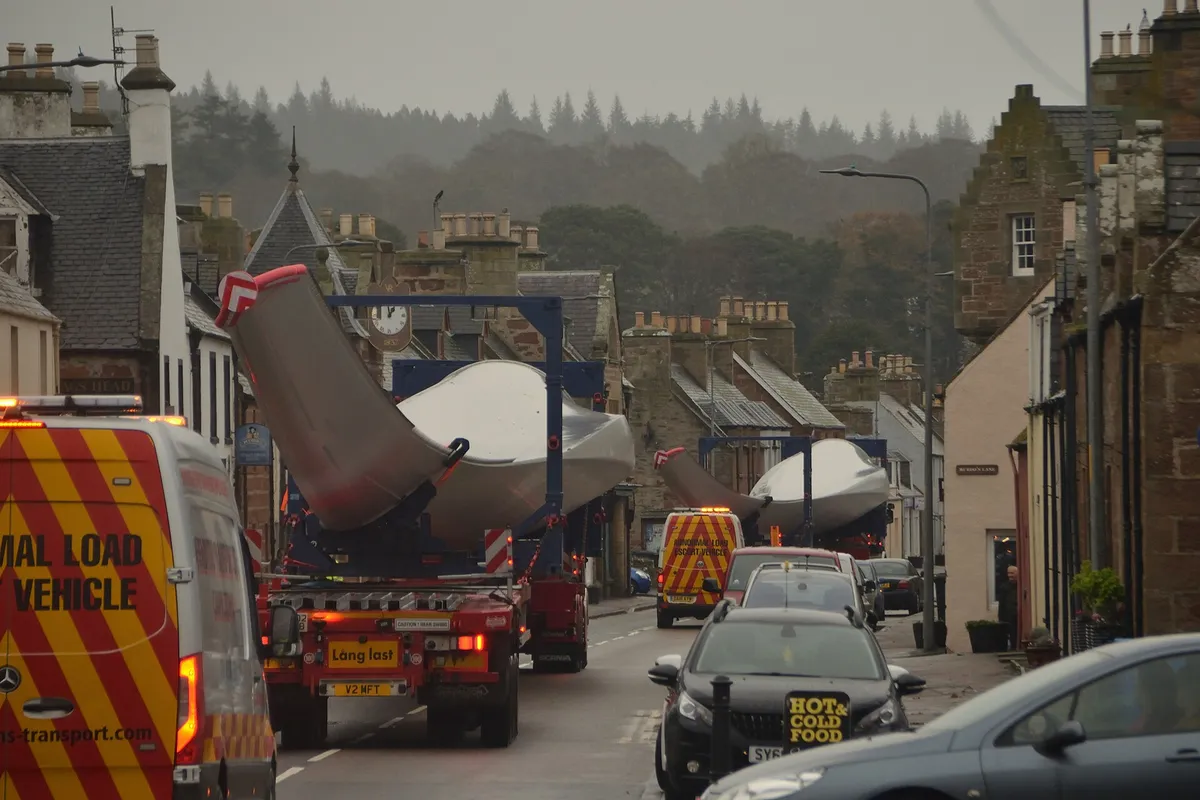
Heavy haulage for onshore wind turbines
A wind farm is made up of few but extremely bulky components – and every single one has to arrive accurate to the metre and within the booked crane slot. Oversize Transports moves rotor blades, tower sections, nacelles and hubs with individual weights of up to 200 tonnes to onshore sites – across the EU and via our own corridors to Turkey, the Caucasus and Central Asia. Project developers, turbine manufacturers and EPC contractors receive door-to-door handling with feasibility study, permit management and a dedicated project manager, timed to the assembly sequence and the main crane slot.
Typical wind energy components
- Rotor blades: single blades from 60 to over 90 metres long – the longest oversize item of any turbine
- Tower sections: steel and concrete sections with large diameters, in several cans per tower
- Nacelles: compact heavy loads with generator, gearbox and controls
- Hubs and rotor stars: tall, round components with demanding load securing
- Add-on parts: blade bearings, transformer stations, control cabinets and ballast
Rotor blades: excess length as a discipline of its own
With rotor blades it is not the weights that are decisive, but length, overhang and curve geometry. For blades beyond the 60-metre mark we use vehicle combinations with self-steering rear dolly axles whose wheelbase adapts to the blade length and which actively steer the rear end around tight bends. Where roundabouts, hairpins or gradients block the conventional horizontal run, blade adapters and blade lifters come into play: they pick up the blade at the root and raise it hydraulically, so that the tip can be swung over obstacles or lifted clear. Which technique is economical and capable of being permitted is determined by the feasibility study along the specific route.
Vehicle technology and load securing
The vehicle technology follows the component strictly. Tower sections with large diameters run on low-slung platforms so that the headroom under bridges and overhead lines is maintained; particularly large base sections are transported where necessary using inloader or special frame concepts. Nacelles and hubs are compact but heavy and high in their centre of gravity – here a fine axle load distribution counts just as much as form-fitting load securing agreed with the manufacturer. For rotor blades we combine self-steering rear dollies with low-vibration bedding at the root and the shell, so that the laminate remains undamaged even over long stages. Requirements from the manufacturer's transport instructions – on maximum tilt angles, bearing points or permissible accelerations, for example – are incorporated as binding inputs into the driving profile and route selection before the vehicle is provided.
Process: feasibility, permit, transport
It begins with the feasibility study: we compare the dimensions, weights and centre of gravity of each component against the route – bridge load ratings, headroom, curve radii and the often unsurfaced access up to the crane pad. On this basis you receive a fixed-price quote. We then take over permit management: the authorisation under StVO §29 in Germany, the equivalents in the transit countries, plus the prescribed BF3/BF4 escort vehicles and, where imposed, the police escort. During transport, a dedicated project manager runs the shipment, coordinates the main crane at destination and remains available around the clock – precisely the decisive difference on night runs and tight assembly windows.
Site access, night runs and the assembly cycle
Wind farms are rarely next to a motorway: the last kilometres lead over field and forest tracks, freshly laid crane pads and narrow village through-roads. We check this access in advance – with a route survey where necessary – and agree it with municipalities, landowners and the track builder. Because of the oversize dimensions, many stages can only be driven at night, when traffic and oncoming traffic have died down; night-driving windows, closure periods and escort conditions are calculated in from the outset. We time the deliveries strictly according to assembly logic: first the tower cans in sequence, then the nacelle and hub, and finally the blades – so that the main crane keeps working instead of waiting expensively for components.
On series deliveries over several weeks you keep one point of contact instead of twenty separate dispatches. We keep loading lists, delivery notes and crane slots consistent and agree buffer areas on site. Wind energy is at the same time part of our broader energy portfolio – from transformers through turbines to grid components. For projects east of the EU too – wind farms in Kazakhstan, Azerbaijan or Georgia – we plan the chain end to end via the sanction-free Middle Corridor and handle customs and transit clearance with T1 or TIR. The basis of every delivery remains the right heavy haulage solution with the right vehicle concept.