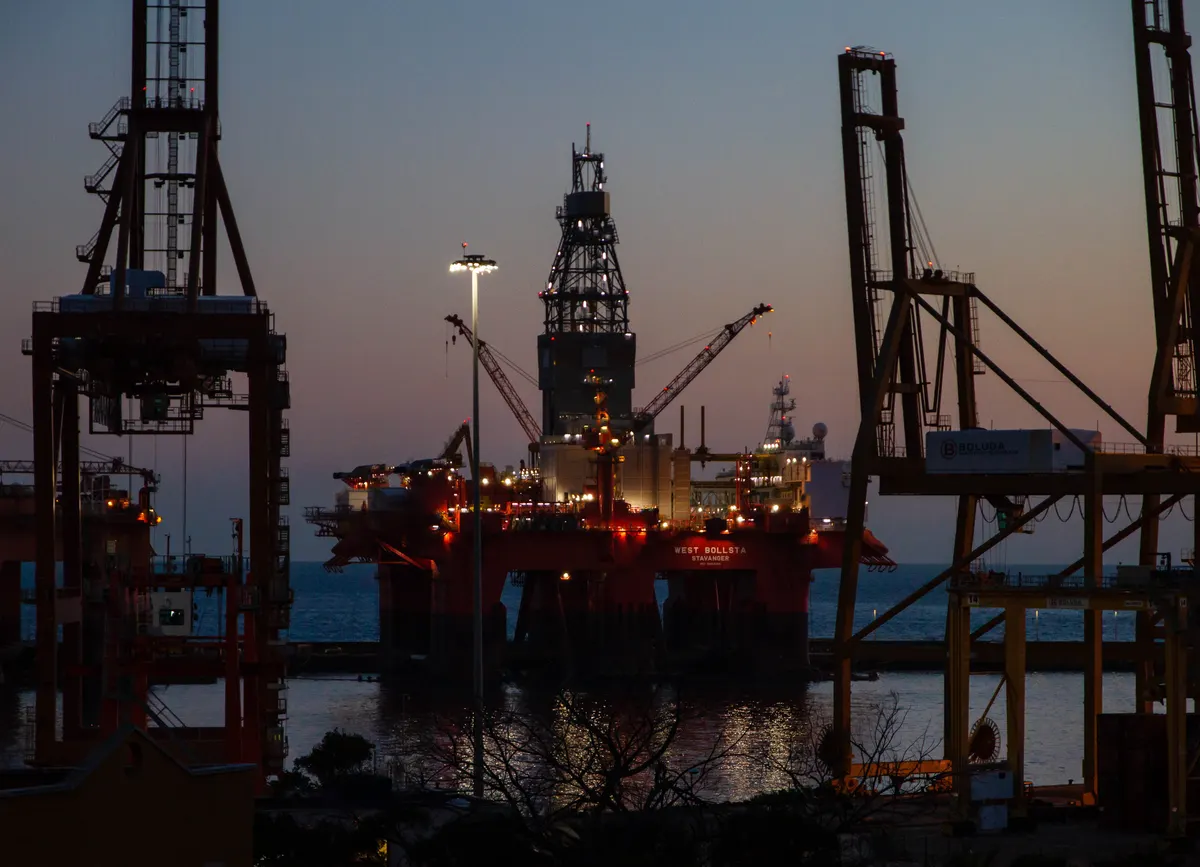
Heavy haulage for the oil and gas industry
Upstream, midstream or downstream – the oil and gas industry moves some of the largest single loads there are: pressure vessels, column sections, compressor stations and complete process modules. Oversize Transports handles these transports with individual weights of up to 200 tonnes – within the EU as well as to Turkey and to the Caspian production region with Kazakhstan, Turkmenistan, Azerbaijan and Uzbekistan. EPC contractors, plant builders and operators receive door-to-door handling in which feasibility, permits, customs and sanctions screening come from a single source.
Typical loads from oil and gas
- Process equipment: pressure vessels, separators, heat exchangers and reactors
- Columns: distillation and absorption columns, complete or in oversize sections
- Rotating equipment: compressors, pump units and turbine packages
- Pipeline construction: large-diameter pipes, fittings, pig traps and valves
- Modules: skid-mounted process units, e-houses and flare components
Process: feasibility, permit, transport
The feasibility study is particularly critical for oil and gas components: the excess length of columns, the high centres of gravity of vessels and the often remote destination sites call for a robust route analysis covering bridge load ratings, headroom and curve geometry. You then receive a fixed-price quote for the entire chain. Under permit management we obtain the authorisation under StVO §29 and all equivalents in the transit countries, provide BF3/BF4 escort vehicles and coordinate the conditions imposed by the authorities. During transport, your dedicated project manager controls every stage, reports border crossings proactively and remains available 24/7 – across all time zones of the corridor.
Equipment and particular requirements
For compact heavy loads we use low-loaders and modular trailers, for long loads such as column sections correspondingly configured vehicle combinations, and for tall equipment semi low-loaders with verified remaining height. We agree lifting lugs, saddle positions and transport frames with the manufacturer; crane and loading coordination at the plant, the port and the site is part of the scope of services. For module deliveries on plant projects we dispatch series of transports according to the assembly sequence – decisive when a tight erection window applies at destination.
Project series and time-critical spare parts
Plant projects in the oil and gas industry are rarely done with a single transport: a process module package quickly comprises dozens of oversize shipments that have to arrive in assembly sequence and in step with the erection plan. We take on the series planning including consistent loading lists, delivery notes to the site and coordination of buffer areas – one point of contact for all transports instead of awarding each trip separately.
The counterpart is turnarounds and unplanned shutdowns: when a heat exchanger or compressor rotor is blocking the restart, we dispatch individual transports with priority and a shortened lead time. And we stay honest about it: permit deadlines and ferry schedules can only be accelerated to a limited extent, and that is exactly what we tell you before you place the order – with a realistic schedule instead of an optimistic promise that falls apart at the first border. For recurring spare parts flows between European manufacturers and Caspian sites we set up fixed procedures on request, with stored freight data and clarified customs processes – that shortens every subsequent transport.
The Caspian region: corridor, customs and sanctions
We reach the major oil and gas projects on the Caspian Sea via the Middle Corridor: Turkey–Georgia–Azerbaijan and by ferry across the Caspian Sea to Kazakhstan or Turkmenistan. This route completely avoids Russia, Belarus and Iran – important, because oilfield equipment in particular is partly subject to goods-related sanctions restrictions. Before every shipment we check the relevant goods lists and the sanctions situation of all transit states; only permissible goods are carried, under permissible procedures. We handle customs and transit clearance with T1 or TIR throughout, including the ferry booking and coordination at the transhipment points. That turns even a 4,000-kilometre corridor into a calculable delivery route.