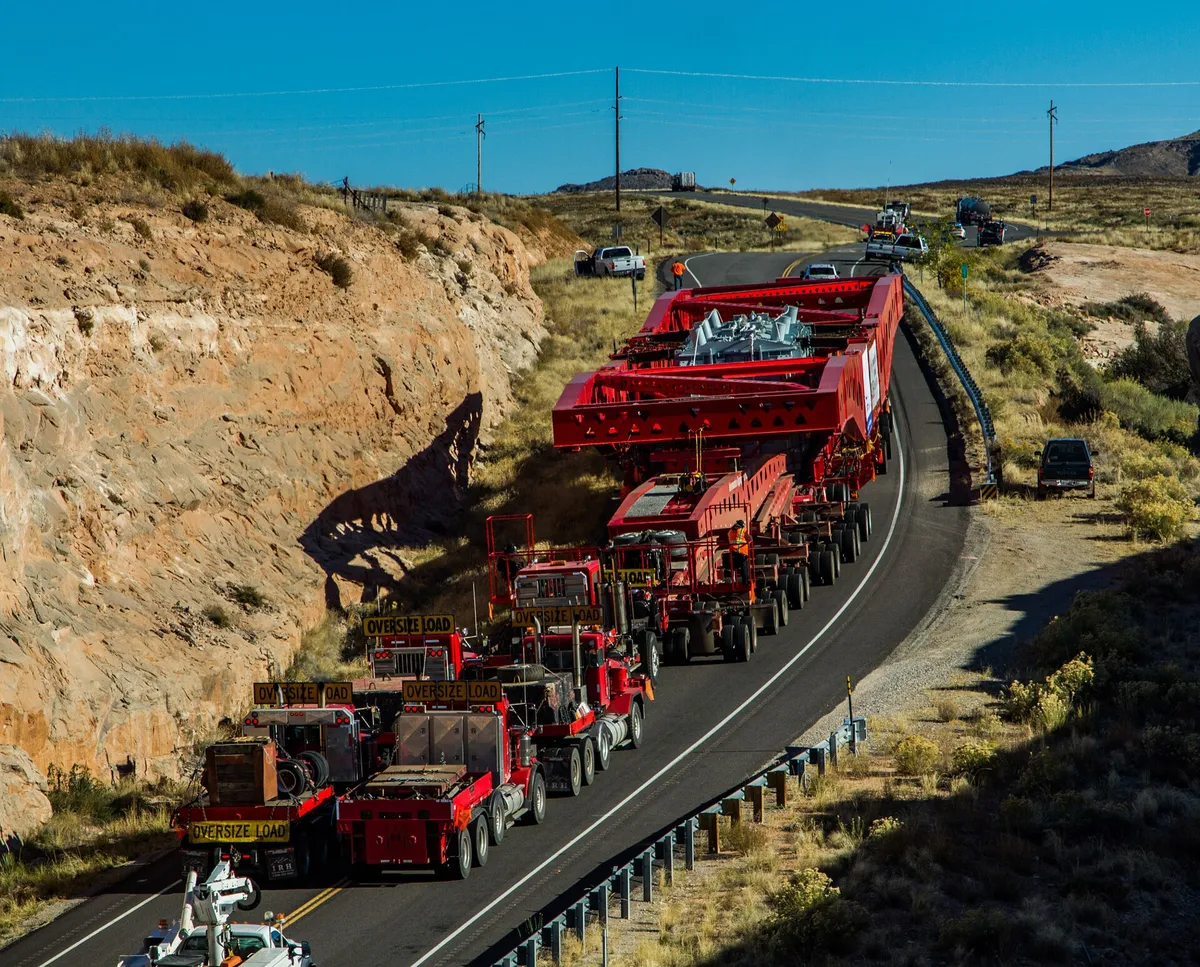
Heavy haulage for power generation and grid expansion
Whether grid reinforcement, power plant overhaul or a greenfield wind farm: energy projects stand or fall with the on-time delivery of a few but very large components. Oversize Transports moves transformers, turbines and generators with individual weights of up to 200 tonnes – across the EU and via our own corridors to Turkey, the Caucasus and Central Asia. Utilities, plant builders and EPC contractors receive door-to-door handling with feasibility study, permit management and a dedicated project manager, timed to assembly dates and crane slots. For blades, towers and nacelles we have a dedicated page on wind energy transport.
Typical loads from the energy sector
- Grid technology: power transformers, reactors, compact substations and switchgear modules
- Power plant technology: turbines, generators, rotors and condenser components
- Wind energy: tower sections, nacelles, hubs and oversize rotor blades
- Solar and storage: transformer stations, inverter containers and battery storage modules
- Hydropower: runners, shafts and generator components for new build and overhaul
Process: feasibility, permit, transport
The feasibility study comes first: bridge load ratings, headroom, roundabouts and the access to the site or substation are checked against the dimensions and weights of your component. On this basis you receive a fixed-price quote. We then take over permit management – the authorisation under StVO §29 in Germany, the equivalents along the international route – and provide the prescribed BF3/BF4 escort vehicles. During transport, your dedicated project manager coordinates loading, driving windows and the crane set-up at destination and remains available 24/7 until the component stands on its foundation.
Equipment and particular requirements of energy components
For heavy compact loads such as transformers we use low-loaders and modular trailers with fine axle load distribution; semi low-loaders for tall components, and correspondingly configured combinations for long loads such as tower sections. Transformers and generators are shock-sensitive – load securing, driving profile and route selection are designed accordingly, and we coordinate loading closely with the manufacturer and the crane partner. For wind farms we plan the delivery sequence according to assembly logic so that the main crane keeps working instead of waiting for components. The access to the site – from the last motorway kilometre to the crane pad – is also checked in advance and, where necessary, agreed with municipalities and landowners.
Grid outages, crane slots, assembly cycles
Energy transports are rarely flexible on dates: a replacement transformer has to be in place within the grid operator's planned outage window, a turbine during the power plant's overhaul shutdown, the large component within the booked slot of the main crane. We therefore plan backwards from the target date and set the loading day, driving windows, night-driving conditions and buffer times so that the transport arrives before the critical window – not in the middle of it. Your project management receives fixed reporting points for every stage.
The reverse case is also part of everyday business: in the event of breakdowns or brought-forward overhauls we organise replacement deliveries with a shortened lead time and tell you honestly which permit deadlines can be accelerated and which cannot. For wind farms and solar fields with dozens of individual transports we take on the series planning, including coordination with site management, crane partner and the municipalities along the access route. This keeps even a delivery period of several months controllable – with one point of contact instead of twenty separate trades.
Energy projects as far as the Caucasus and Central Asia
Wind and solar parks in Kazakhstan and Uzbekistan, hydropower in Georgia, grid expansion in Azerbaijan: many energy projects today lie east of the EU. We serve these destinations via the Middle Corridor (Turkey–Georgia–Caspian Sea) – the sanction-free alternative to routes through Russia or Belarus, which we consistently avoid using. Before every shipment we check the current sanctions situation including goods-related restrictions; only permissible goods are carried. We handle customs and transit clearance with T1 or TIR throughout, including all transit permits. That way your component arrives at the project site as a plannable milestone – not as an open risk item in the schedule.