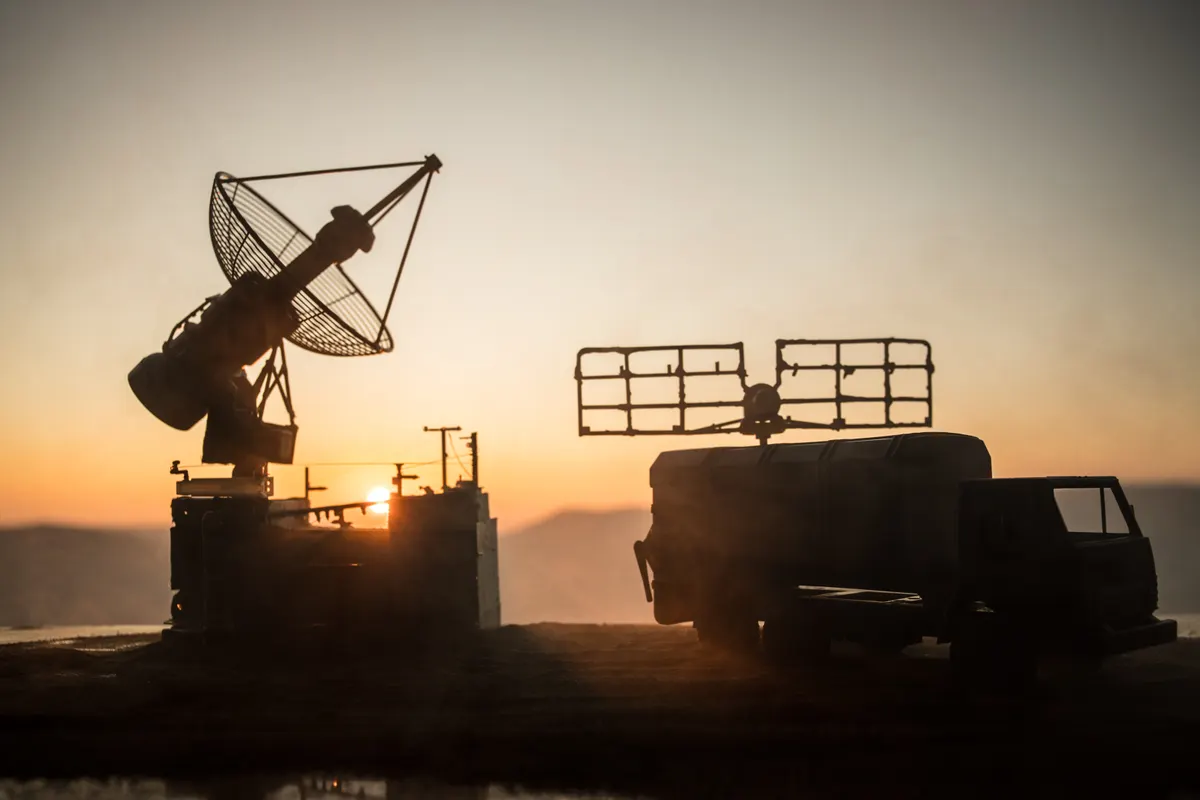
Heavy haulage for the defence industry and military logistics
Transporting large military equipment combines two demanding worlds: the technical logistics of a heavy haulage movement and the legal requirements of export control. Oversize Transports transports defence goods with individual weights of up to 200 tonnes for manufacturers, maintenance and repair companies and logistics partners of the armed forces – within the EU and, after careful case-by-case assessment, to Turkey and the Caucasus. Discretion, clean paperwork and a dedicated project manager who is accountable for every stage are not optional extras here, but standard.
Typical loads from the defence sector
- Tracked vehicles: main battle tanks, recovery and engineer vehicles as well as driver training variants
- Wheeled vehicles: protected transport and command vehicles, special bodies
- Systems technology: radar and command systems, containerised operational modules
- Maintenance and repair: assemblies, engines and hulls between plant and depot
- Civil equipment for military infrastructure: construction plant and installations for estate projects
Export control: clear responsibility, sound verification
Important for context: responsibility under export control law lies with the exporter. Authorisations under the German War Weapons Control Act, the EU Dual-Use Regulation 2021/821 and the German Foreign Trade and Payments Ordinance – in Germany via BAFA, and for war weapons via the responsible federal ministry – must be obtained by the exporter. Our part as the carrier: for each shipment we verify that the required authorisations and documents are complete, screen the parties involved against the relevant sanctions lists and check the embargo situation of the country of destination and of all transit countries. If something is missing, we do not drive – that protects both sides.
Process: feasibility, permit, transport
The feasibility study clarifies the route, bridge load ratings, headroom and loading – for instance whether a tracked vehicle can drive on under its own power or whether a crane is provided. You then receive a fixed-price quote. Under permit management we obtain the road traffic authorisations: StVO §29 in Germany, the equivalents in all transit states, plus BF3/BF4 escort vehicles and, where imposed, police escort. During transport, the need-to-know principle applies: no publication of cargo or route, communication only with named contacts, 24/7 availability of the project manager.
Working with authorities and clients
Military heavy haulage movements come about through the interplay of many bodies: road traffic authorities and motorway offices for the authorisation and the conditions imposed, the police for escort and route protection, plus the client's security and reporting requirements. We know these coordination channels and take over the coordination in full – from surveying critical sections of the route, through registering convoy movements, to selecting time windows in which sensitive cargo attracts as little public attention as possible.
On the client side we work for manufacturers and maintenance and repair companies as well as for civil logistics partners of the armed forces – for factory transfers, depot relocations or transports to training areas, for example. Every shipment is given a documented procedure with named responsible persons, fixed reporting points and clear escalation paths. For relocations with a fixed exercise or loading date we plan backwards from the time window and set buffers deliberately conservatively: a missed shipping or rail loading slot can rarely be made up on military transports.
Equipment and particular requirements
We transport tracked vehicles on low-loaders with suitable access ramps and a track-capable loading deck; semi low-loaders and modular trailers are available for heavy systems technology and oversize loads. Weights of around 60 to 70 tonnes – the class of modern main battle tanks – are routine figures for us, well below our 200-tonne limit. For relocations involving several vehicles we dispatch convoys with coordinated driving windows. For destinations in the Caucasus we assess not only the permit situation but also the regional embargo and sanctions situation on a case-by-case basis; routes through Russia, Belarus or Iran are not an option. Civil equipment for military estates – construction plant, containers, plant technology – is also handled to the same standards: a surveyed route, complete paperwork, a documented procedure and one point of contact who is accountable for every stage and reports deviations immediately.