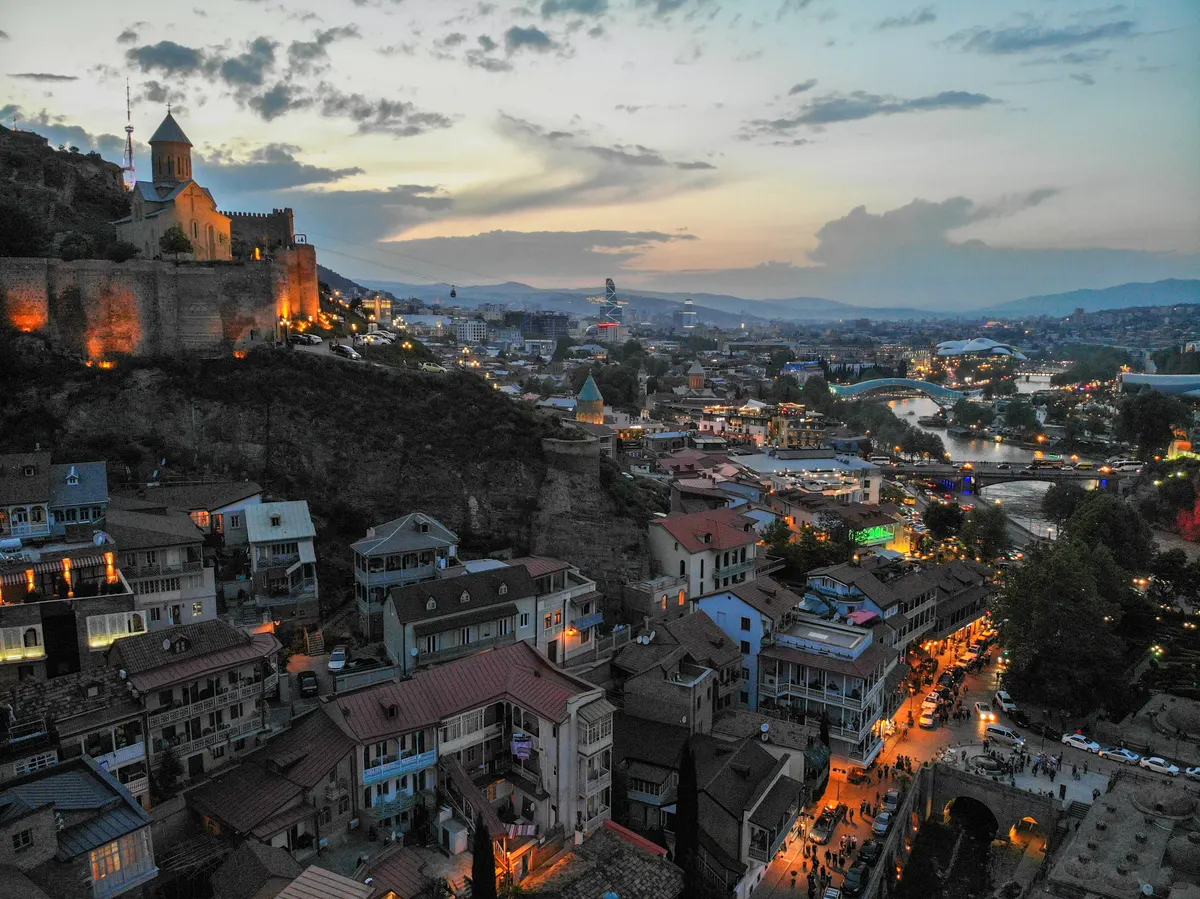
Heavy haulage to Georgia: target market and transit hub
Georgia matters twice over for heavy haulage logistics: as a destination country for hydropower, infrastructure and industrial projects – and as the heart of the Middle Corridor, which today carries a large share of overland traffic towards Azerbaijan, Armenia and Central Asia. Oversize Transports, a brand of HSNK s.r.o., plans and runs heavy haulage and abnormal load transports of up to 200 tonnes to Tbilisi, Batumi, Poti, Kutaisi and Rustavi – door to door, with permits and customs clearance from a single source.
Scope of services for Georgian projects
- Feasibility study: bridge load ratings, tunnel and clearance heights, mountain passes – from the factory gate to the unloading point
- Permit management: German road traffic regulations (StVO §29) and the equivalents in all transit countries and in Georgia
- Equipment: low-loaders, semi low-bed trailers and modular trailers up to 200 t
- BF3 / BF4 escort vehicles (German escort classification) within the EU, escorting under national law in Turkey and Georgia
- Customs and transit handling: T1, TIR carnet, ATA carnet
- Crane and loading coordination, including port transhipment at Poti/Batumi
How it works: feasibility, permits, transport
First we check the dimensions, weight and centre of gravity of your load against the actual route. On that basis you receive a fixed-price quote – no open-ended calculation, no surcharges for foreseeable permit conditions. Once the order is placed, we obtain all permits, provide escort vehicles and coordinate loading and unloading with a crane where required. Your dedicated project manager is available 24/7 while the transport is running. You receive a status report at every border crossing, so the site, crane and installation team can plan the arrival reliably.
Route and transit
By road the way leads through Hungary, Romania and Bulgaria into Turkey and across the Sarpi border crossing on the Black Sea coast into Georgia. Alternatively we ship oversize and heavy cargo by ferry or as break bulk across the Black Sea directly to Poti or Batumi – often the best option for very tall or very heavy packages. From the port our vehicles take over the pre-carriage to project sites across the country or the onward leg towards Armenia and Azerbaijan; we arrange the necessary transit permits well in advance. Mountain sections in the Greater and Lesser Caucasus call for a robust route survey, which we carry out before every quote.
Customs in Georgia
Georgia is not an EU member; every transport is cleared at the border or at an inland customs office. We move consignments under the T1 procedure up to the EU external border and under the TIR procedure onward into Georgia; for temporary imports – construction machinery, test and exhibition equipment – we use the ATA carnet. Georgian customs clearance is considered comparatively fast and digitalised, but it requires complete and consistent papers: we align the commercial invoice, packing list, transport documents and technical description of the load before departure.
Sanctions: the sanction-free southern route
Georgia is the core of the sanction-free route between Europe, the Caucasus and Central Asia: Turkey–Georgia–Caspian Sea, the so-called Middle Corridor. The northern route through Russia is ruled out for many goods because of EU sanctions against Russia and Belarus. Where consignments could be relevant under export control law, the rule is: responsibility rests with the exporter – we review the route and procedure side for each shipment and document everything cleanly.
Typical goods
To Georgia we regularly carry turbine and hydropower components, construction machinery, transformers, plant modules and crane sections. Many consignments arise around Georgian hydropower and road construction projects as well as port development on the Black Sea coast; accordingly, we often combine a sea leg and a road leg within one project. We first quote costs as a non-binding indicative range – depending on route, weight and permit situation – and fix them as a fixed price after the feasibility study.