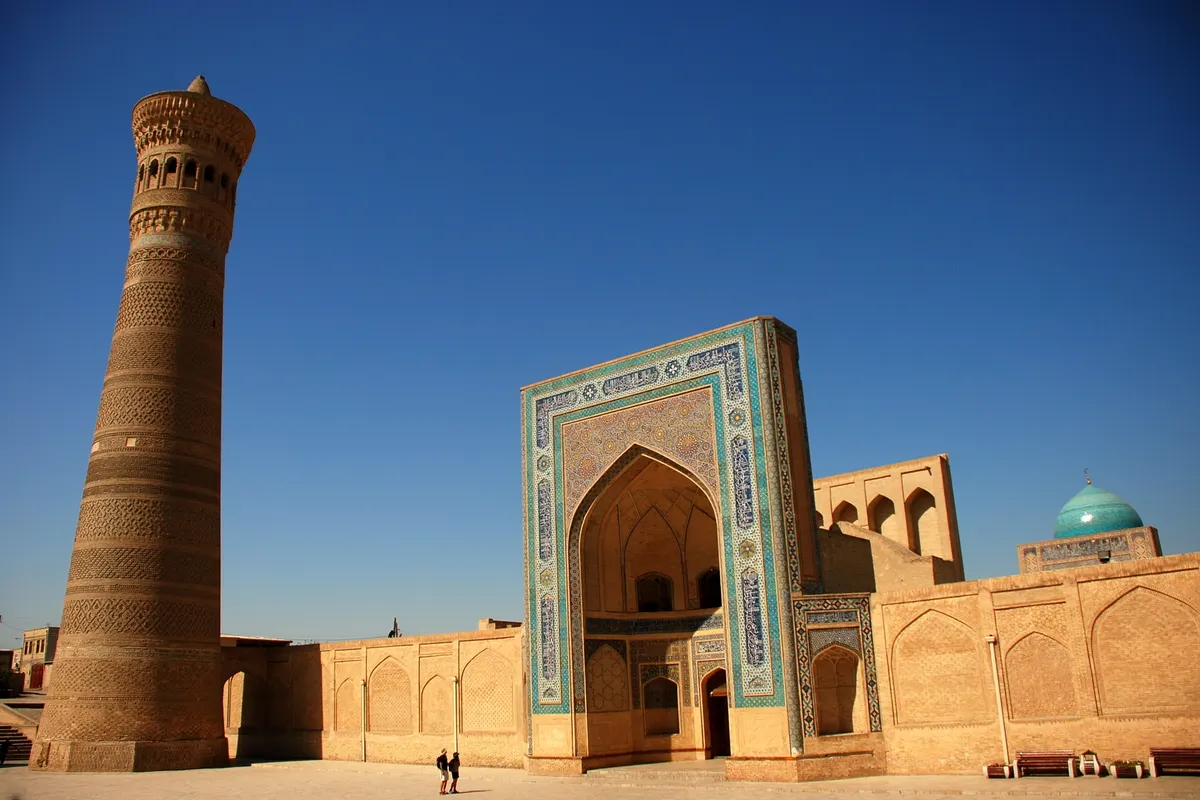
Heavy haulage to Uzbekistan: a growing market, a long route
Uzbekistan is investing heavily in industry, energy and infrastructure – and demand for machinery and plant transports from Europe is rising accordingly. Logistically the country is a challenge: it is one of only two doubly landlocked countries in the world, so every consignment crosses at least two further landlocked states. Oversize Transports, a brand of HSNK s.r.o., plans and runs heavy haulage and abnormal load transports of up to 200 tonnes to Tashkent, Samarkand, Bukhara, Navoiy and project sites across the country – via the sanction-free Middle Corridor.
Scope of services for Uzbek projects
- Feasibility study of the entire route, including the Caspian ferry, transit sections and bridge load ratings through to the unloading point
- Permit management: German road traffic regulations (StVO §29) plus special permits for all transit countries and Uzbekistan
- Low-loaders, semi low-bed trailers and modular trailers for packages up to 200 t
- BF3 / BF4 escort vehicles (German escort classification) within the EU, escorting under national law along the corridor
- Customs and transit handling: T1, TIR carnet, ATA carnet and Uzbek import clearance
- Crane and loading coordination as well as multimodal variants with rail sections
How it works: feasibility, permits, transport
Everything starts with a technical review of your load against the actual route – from the factory gate to the site in Uzbekistan, including the ferry transhipment on the Caspian Sea. On that basis you receive a fixed-price quote. Once the order is placed, we apply for all permits, book ferry slots, coordinate escort vehicles and accompany the transport with dedicated project management – available 24/7, with a status report at every border crossing, so your site can plan the crane and installation window reliably.
Route: across the Caspian Sea and through Kazakhstan or Turkmenistan
The Middle Corridor runs through Turkey, Georgia and Azerbaijan to the ferry port of Alat near Baku. From there, two continuations are available: by ferry to Aktau/Kuryk in Kazakhstan and on by road via Beyneu into Uzbekistan – or by ferry to Turkmenbashi and through Turkmenistan to the Uzbek border. Which variant fits better depends on ferry availability, transit permits and the destination region; we plan both and decide within the project according to the situation. For suitable packages we also examine rail sections from the Caspian port. Within Uzbekistan the main axes are readily passable; the critical points are individual bridges and town centres, which we check against axle load and overall height in advance.
Customs in Uzbekistan
Uzbekistan is neither an EU nor an EAEU member and clears imports under its own customs law. The proven set-up is the T1 procedure up to the EU external border and a TIR carnet across the entire corridor through to the Uzbek customs office of destination; for temporary imports – construction equipment with re-export, for example – the ATA carnet is an option. On a route with up to six border crossings and one ferry transhipment, document quality is the single most important time factor: we align the commercial invoice, packing list and technical cargo description in full before departure.
Sanctions: Middle Corridor instead of the northern route
The traditional northern route to Central Asia ran through Russia – it is ruled out for many goods by EU sanctions against Russia and Belarus. We therefore consistently run Uzbek traffic via the sanction-free Middle Corridor Turkey–Georgia–Caspian Sea. For technically sensitive goods we review the export control and re-export requirements for each shipment; legal responsibility rests with the exporter, and we supply the route- and procedure-side safeguards.
Typical goods and costs
We regularly carry textile and machine tools, power plant and substation equipment, mining equipment for the Navoiy region as well as construction machinery and plant modules. We first quote costs as a non-binding indicative range – depending on route, weight and permit situation – and, after the feasibility study, as a binding fixed price.