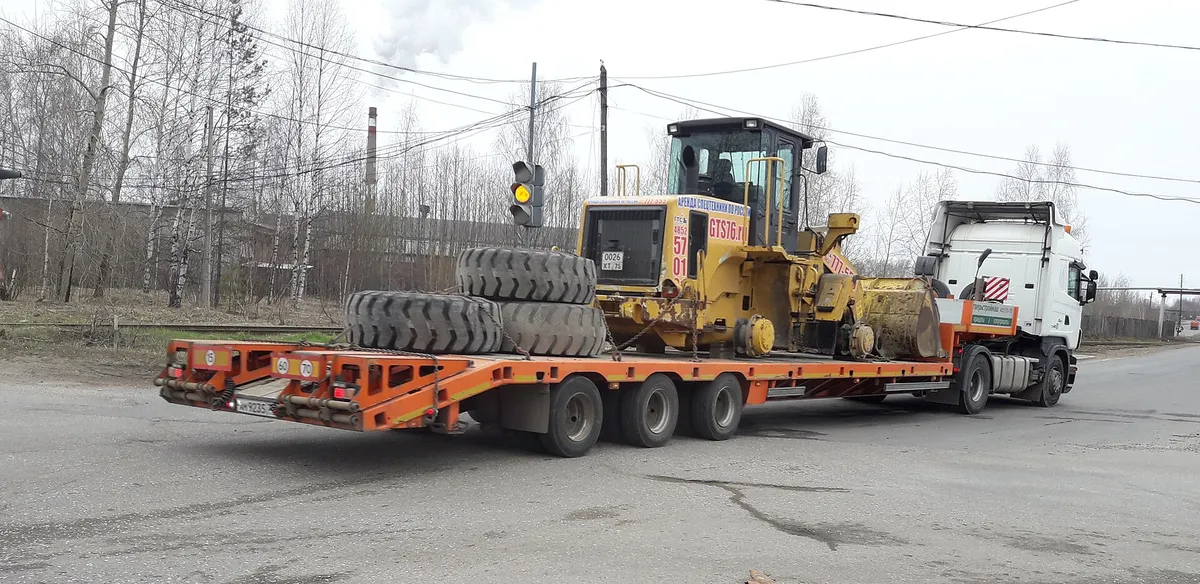
Heavy haulage for mechanical and plant engineering
A press that does not arrive is a production line that does not start. Oversize Transports moves machines and plant components with individual weights of up to 200 tonnes – from the machine tool manufacturer to the end customer, between plants during factory relocations, or as an export shipment to Turkey, the Caucasus and Central Asia. Machine builders, plant designers and used machinery dealers receive end-to-end handling: feasibility study, permits, crane and loading coordination, customs and a dedicated project manager right through to installation at destination.
Typical loads from mechanical engineering
- Forming technology: presses, press frames, rams and beds – also as a dismantled set of components
- Machine tools: machining centres, gantry milling machines, lathes and grinding machines
- Plastics technology: injection moulding machines and extrusion lines
- Complete lines: production and assembly lines as multi-part combined projects
- Special machinery: test rigs, printing machines, paper and packaging technology
Process: feasibility, permit, transport
In the feasibility study we compare the dimensions, weights and centre of gravity of the machine against the route – including bridge load ratings, headroom, factory accesses and workshop doors. You then receive a fixed-price quote covering the complete service. We handle permit management in full: the authorisation under StVO §29 in Germany, the corresponding procedures in all transit countries, plus BF3/BF4 escort vehicles as required. During transport, a dedicated project manager controls loading, the journey and unloading, liaises with your assembly team and is available 24/7 – even when the machine has to pass through the factory gate on a Saturday evening because production only stops at the weekend.
Loading, equipment and factory relocations
Depending on the machine, we use low-loaders, semi low-loaders or modular trailers. Crane and loading coordination at both ends is part of the scope of services: we agree lifting points, spreader beams and lifting times with the manufacturer, the dismantling contractor and the crane partner. For factory relocations we dispatch the vehicles according to your dismantling and re-erection sequence, so that components arrive just in time instead of having to be stored for weeks. Sensitive guideways and spindles remain protected by coordinated load securing and careful route selection; the manufacturer's transport requirements – on tilt angles or packaging, for example – are incorporated as binding inputs into the planning before the vehicle is provided.
Used machinery, auctions and tight workshops
Alongside new machines ex works, we continuously transport used machinery for dealers and buyers – following auctions or plant closures, for example. A typical challenge: the machine is still inside the hall, the seller does not provide a crane, and the collection window is tight. In such cases we coordinate dismantling and loading partners, clarify hall doors, floor loading and manoeuvring routes in advance, and take care of the export documents at the same time.
Tight factory accesses are the rule rather than the exception in mechanical engineering: sites that have grown over time, gates from an era of smaller machines, courtyards with limited swept paths. In the feasibility study we re-measure critical points before the transport is confirmed – and propose alternatives where it gets tight: a different vehicle concept, an adjusted approach direction, or transhipment onto more compact equipment for the last few metres to the installation point.
Machinery exports to Turkey, the Caucasus and Central Asia
Turkey is one of the most important markets for European mechanical engineering – and one of our regular corridors. Further east we deliver to Georgia, Armenia and Azerbaijan as well as Kazakhstan, Turkmenistan and Uzbekistan, consistently via the sanction-free Middle Corridor, bypassing Russia and Belarus. We check the sanctions situation and any goods-related restrictions before every shipment. Customs clearance is handled with T1, TIR or – for exhibition machines and demonstration equipment, for example – with an ATA carnet. That turns a machinery export from a customs adventure into a delivery date your customer can rely on.