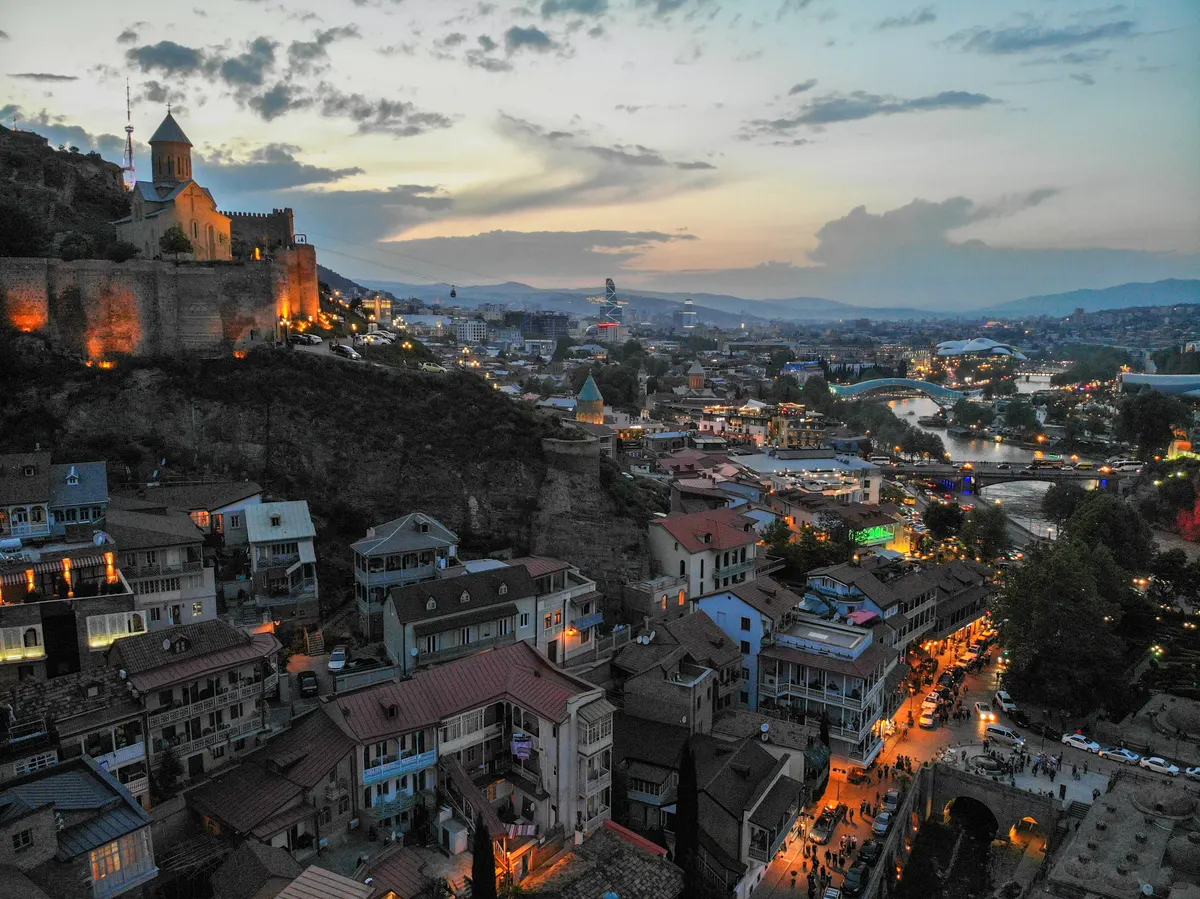
How does a heavy transport from Prague to Tbilisi work?
A heavy transport from Prague to Tbilisi follows the Middle Corridor: from the Czech capital via Austria, the Balkans and Turkey, then across the border at Sarp or Türkgözü into Georgia and on to the capital Tbilisi. The distance is around 3,500 km. Prague is also our own head office – for lanes starting in our home region, our planning is particularly closely interlocked.
Georgia is the hub for onward lanes to Azerbaijan and – via the Caspian ferry – to Central Asia; the route is deliberately planned without any Russian transit.
Permits from the Czech Republic – no German §29 section
Because the route from Prague runs via Austria and the Balkans, the German §29 StVO procedure (German road traffic regulations) generally does not apply. The chain begins with the Czech special permit, followed by the national permits of Austria, the Balkan states, Turkey and Georgia. The approach through Eastern Anatolia is mountainous; gradients, tight turning radii and clearance heights at tunnels and bridges have to be surveyed in advance. We check the route for load-bearing capacity and clearance profile before the equipment is assigned.
Customs clearance: T1 and TIR
As several non-EU countries are crossed, the consignment travels under a transit procedure – as T1 from the external EU border and/or under a TIR carnet. TIR reduces checks at the intermediate borders; import clearance takes place in Georgia. We align the documents with the border posts in advance so that no waiting times arise at Kapıkule and Sarp.
Equipment selection and load securing
Steered axle lines and sufficient ground clearance are essential for the mountainous sections. Heavy single items are loaded onto low-bed or modular axle trailers; our equipment overview shows the right choice. Loads are secured by positive and friction locking in line with recognised engineering standards – lashed, chocked and braced against tipping. In case of excess width or height we accompany the transport with escort vehicles up to BF3/BF4 escort.
Georgia as a corridor hub
Tbilisi is the logistics node of the South Caucasus: from here, lanes branch off to Baku (Azerbaijan), Yerevan (Armenia) and onwards towards the Caspian Sea. Country details can be found on our page on heavy haulage to Georgia.
Feasibility study and axle load concept
Every Tbilisi lane starts with a technical review: weight, length, width, height and centre of gravity of the cargo determine the axle load distribution and the vehicle type. For the mountainous approach through Eastern Anatolia, climbing ability, turning radii and ground clearance are assessed with particular care. The route is driven virtually in order to identify critical bridges, tunnels and town passages at an early stage.
Time windows and border coordination
The transit time to Tbilisi depends largely on the driving-time restrictions of the transit countries and the opening hours of the Kapıkule and Sarp borders. We interlock night driving bans, weekend restrictions and border service hours so that the transport does not wait at closed crossings. With a multi-stage permit chain, this detailed planning is decisive for a smooth operation.
Oversize Transports as an independent project partner
Oversize Transports is the brand of HSNK s.r.o., based in Prague, and operates as an independent heavy haulage forwarder. Particularly for lanes starting in our home region of Prague, we combine feasibility, routing, permits, escorting and customs in one hand. Send us your project by phone or via the enquiry form – we check feasibility and coordinate the permit chain along the Middle Corridor.
Typical cargo types on this lane
Consignments moving to Tbilisi via the Middle Corridor frequently include construction machinery, transformers, boilers, vessels and plant modules. Such goods often involve excess width, excess height or point loads that shape the equipment choice for the mountainous approach. We match trailer, axle lines and securing equipment precisely to the item and document dimensions and condition before departure, so that the permit data remains consistent across all transit countries.
Insurance and risk management
Heavy cargo along the Caucasus corridor calls for suitable transport insurance and clear risk management. We align cover, declared values and the contingency concept with each individual project, so that in the event of damage, responsibilities and handling are unambiguously defined.
Surveying, escort concept and status tracking
Before departure, the cargo is measured exactly and documented photographically; the actual external dimensions feed into every national permit. For the mountainous approach through Eastern Anatolia we define a graded escort concept – from private escort vehicles to official escorts where required. Across the entire route we track the status and stay in contact with the driver and the border posts, so that deviations are identified early and time windows can be readjusted.