Route from Hamburg to Baku via the Middle Corridor
From Hamburg, the heavy haulage transport to Baku runs via the Middle Corridor: through South-Eastern Europe and Turkey, then on via Georgia to Azerbaijan. The distance is around 4,000 to 4,450 km, depending on the routing chosen within Turkey and on the clearance of individual mountain sections. Transit through Russia is deliberately avoided – the Middle Corridor is the established alternative towards the Caucasus and Central Asia.
Oversize Transports acts as an independent project forwarder and organises the lane as a closed chain: feasibility, routing, permits, escorting and customs from a single source.
Borders and permits along the chain
From Hamburg, the German section is permitted via VEMAGS under StVO §29. The national special permits of the transit countries in the Balkans, Turkey, Georgia and Azerbaijan follow. Particularly relevant are the crossings at Kapıkule (entry into Turkey), Sarp or Türkgözü (Turkey/Georgia) and the “Red Bridge” between Georgia and Azerbaijan. Every border has its own opening hours, axle load limits and escort requirements, which we build into the timeline.
Customs clearance: T1 and TIR
Since several non-EU countries are crossed, the consignment moves under a transit procedure – as T1 from the EU external border and/or under a TIR carnet along the entire route. TIR minimises checks at the intermediate borders; import clearance takes place in Baku. We prepare packing lists, value declarations and proofs of origin so that they are consistent at every border.
Equipment, load securing and mountain sections
For the winding sections in Eastern Anatolia and the Lesser Caucasus, equipment selection is decisive: steered axle lines, sufficient ground clearance and – in case of excess height – clearance profiles surveyed in advance. Heavy single pieces are loaded onto modular axles or low-bed trailers, secured by positive and frictional locking and lashed against slipping and tipping. Load securing follows recognised engineering standards.
Escorting in the Caucasus corridor
Depending on dimensions, we escort the transport with our own escort vehicles up to BF3/BF4 escort; in individual countries an official or police escort is additionally mandatory, which we coordinate through local partners. This lane is part of our international heavy haulage transports and can be extended as far as Central Asia if required.
Why Baku is a strategic destination
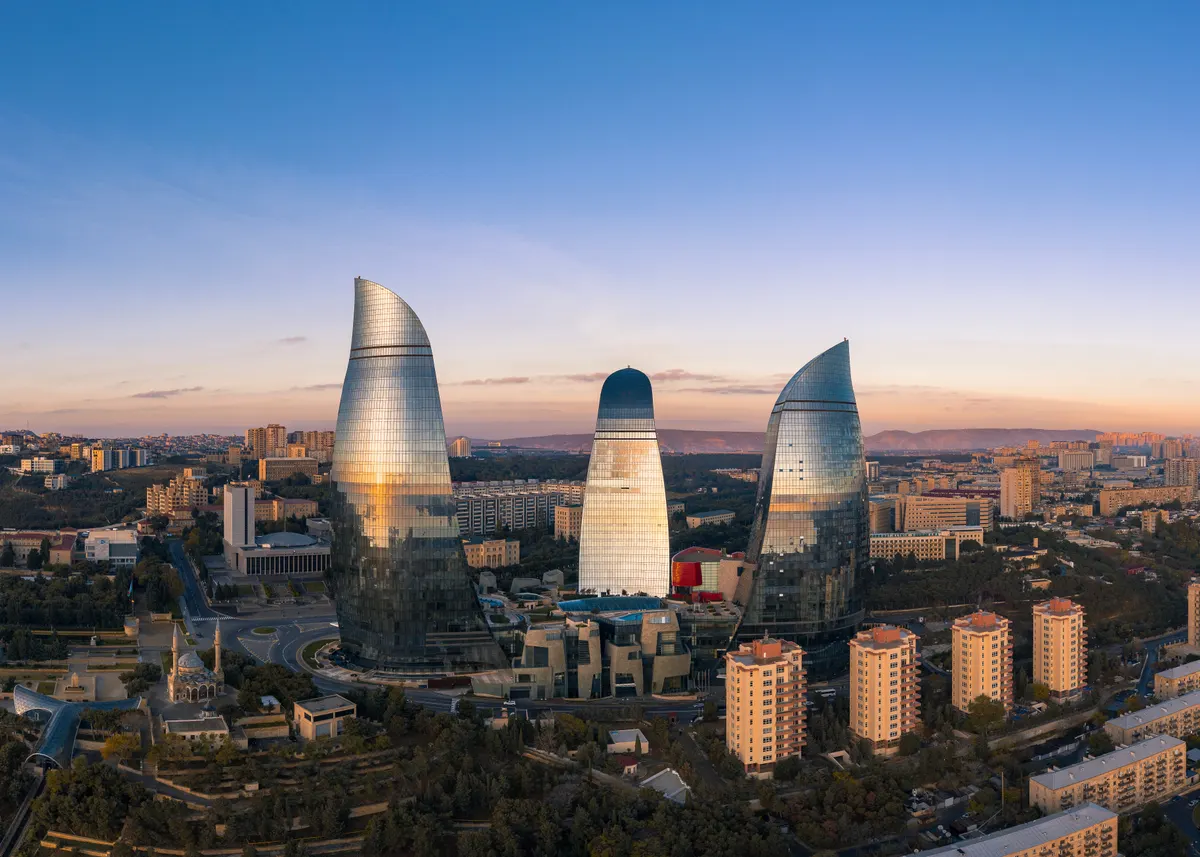
Baku is both the end point of the overland route and the departure port for onward shipping across the Caspian Sea towards Kazakhstan and Turkmenistan. For Azerbaijani requirements and details, see our page on heavy haulage to Azerbaijan.
Feasibility study and axle load concept
Every Baku lane starts with a technical assessment: the weight, dimensions and centre of gravity of the cargo determine the axle load distribution and the vehicle type. For the mountain sections in the Lesser Caucasus, gradeability, curve radii and ground clearance are calculated with particular care. The route is then checked for bridge load capacity and clearance profiles, so that no bottleneck forces a subsequent replanning.
Time windows across several countries
From Hamburg to Baku, the night driving and weekend restrictions of several countries interlock. Every national permit brings its own permitted driving times; on top come the opening hours of the Kapıkule, Sarp and Red Bridge border crossings. We schedule the legs so that arrivals at the borders fall within service hours and standing times are minimised. On the long Caucasus chain, this fine planning matters more than the pure mileage.
Oversize Transports as an independent project partner
As a brand of HSNK s.r.o. from Prague, Oversize Transports organises the Hamburg–Baku lane independently and end to end – from feasibility through to unloading. The Middle Corridor is our speciality, precisely because it opens up the Caucasus without transit through Russia. Contact us by phone or via the enquiry form; we check feasibility and align the permit chain.
Surveying, documentation and escort concept
Before the transport starts, the cargo is measured precisely and documented photographically; the actual external dimensions feed into every national permit. For the Caucasus legs we define a graduated escort concept: private escort vehicles to safeguard excess width, survey runs at critical bottlenecks and, where legally required, an official or police escort. Along the entire route we stay in close contact with the driver and the border posts so that deviations are detected early and permit windows can be readjusted.