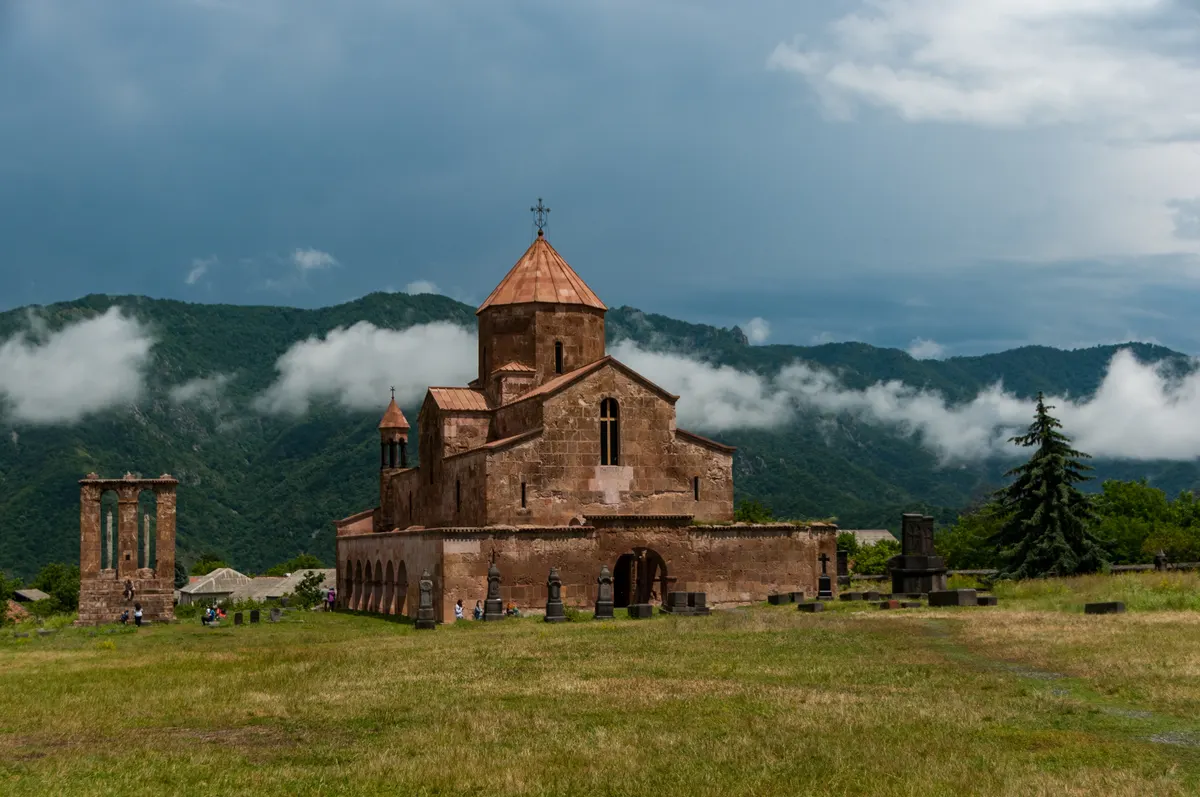
Germany to Yerevan: entry only via Georgia
The heavy haulage transport from Germany to Yerevan follows the Middle Corridor through the Balkans and Turkey to Georgia – and from there onward to Armenia. The direct Turkish-Armenian land border is closed, so the practicable route necessarily runs via Georgia with the border crossing at Bagratashen. The distance is around 4,100 to 4,450 km.
Permits across four transit countries
The German section is applied for as an abnormal load via VEMAGS under StVO §29, followed by the national special permits of the Balkan states, Turkey, Georgia and Armenia. The approach through Eastern Anatolia and the Lesser Caucasus is mountainous; gradients, curve radii and clearance heights at passes and bridges are checked in advance.
Customs: T1 and TIR
Across the non-EU borders, the consignment moves under a transit procedure – as T1 from the EU external border and/or under a TIR carnet. Checks are thereby concentrated on entry and exit; import clearance takes place in Armenia. We align the documents with the border posts in advance so that no unnecessary standing times arise at Sarp and Bagratashen.
Equipment selection and load securing
For the mountainous sections, steered axle lines and sufficient ground clearance are decisive. Heavy pieces are loaded onto low-bed or modular axle trailers and secured by positive and frictional locking in line with recognised engineering standards. In case of excess width or height, we escort the transport with escort vehicles up to BF3/BF4 escort; in individual countries an official escort is additionally mandatory.
Armenia in the Caucasus corridor
Yerevan is closely connected to the South Caucasus corridor via Georgia and is part of our international heavy haulage transports. Because of the closed Turkish-Armenian border and the particular situation with Azerbaijan, the Georgian route is the only option here. Country details can be found on our page on heavy haulage to Armenia.
Feasibility study and routing logic
Because entry into Armenia necessarily runs via Georgia, the routing logic here matters as much as the vehicle engineering. We record weight, dimensions and centre of gravity, define the axle load concept and check the Georgian-Armenian approach via Bagratashen for bridge loads, gradients and narrow passages in the Lesser Caucasus. Only once the route and the equipment match does the project move into execution.
Time windows and border coordination
Across the Balkans, Turkey, Georgia and Armenia, several driving time rules and border opening hours interlock. We schedule the legs so that arrival at Kapıkule, Sarp and Bagratashen falls within service hours and night as well as weekend driving bans are observed. With the closed Turkish-Armenian border and the Georgian detour, this fine planning is particularly relevant.
Oversize Transports as an independent project partner
Oversize Transports is the brand of HSNK s.r.o. from Prague and organises the Germany–Yerevan lane independently and end to end. The South Caucasus via the Middle Corridor – without transit through Russia – is one of our core routes. Enquire about your project by phone or via the enquiry form; we check feasibility and the Georgia route, for which there is no alternative.
Surveying, escort concept and status tracking
Before the transport starts, the cargo is measured precisely and documented photographically; the real dimensions feed into every national permit. For the approach via Georgia to Armenia we define a graduated escort concept – from private escort vehicles through to an official escort where required. Along the entire route we track the status and stay in contact with the driver and the border posts so that arrival at Bagratashen falls within service hours.
Insurance and risk management
Heavy cargo across the South Caucasus calls for suitable transport insurance. We align cover, value declarations and the average concept with the project so that responsibilities and handling in the event of damage are unambiguously defined.
Typical cargo types on this lane
To Yerevan, the route via Georgia frequently carries construction machinery, transformers, vessels, plant components and production machinery. Such goods often bring excess dimensions or point loads, which shape the equipment selection for the Caucasus approach. We match trailer, axle lines and securing equipment exactly to the piece and document dimensions and condition before departure, so that the permit data remain consistent across all transit countries.
Whether a single oversize machine or a complete plant delivery: we calculate every Armenia lane individually and accompany it from the first feasibility study through to unloading in Yerevan – as part of our international heavy haulage transports via the Middle Corridor.