How does a heavy transport from the Baltics to Tashkent work?
A heavy transport from the Baltics to Tashkent deliberately does not take the direct eastern route via Russia and Belarus, but runs southwards via Poland and the Balkans, through Turkey and Georgia, by Caspian ferry to Kazakhstan and on to Uzbekistan. The distance is around 7,000 to 8,000 km, and the transit time clearly runs to several weeks.
Why the southern route instead of the direct eastern route?
The geographically shortest way from Estonia, Latvia or Lithuania to Central Asia would run via Russia and Belarus. That route is ruled out – we use exclusively the Middle Corridor, without Russian or Belarusian transit. From the Baltics, the route therefore first heads south through Poland, on via Slovakia or Hungary onto the Balkans and through Turkey into the Caucasus.
Corridor and border crossings
After the Baltic internal borders, the route runs across the Lithuanian–Polish crossing at Kalvarija/Budzisko, through Poland and South-Eastern Europe to the Turkish border at Kapıkule. From there it continues via Sarp or Türkgözü into Georgia and across the “Red Bridge” into Azerbaijan as far as the port of Baku. After the Caspian ferry come the Kazakh overland stages and the border crossing into Uzbekistan at Gishtkuprik/Yallama towards Tashkent.
The Caspian ferry as the pacemaker
The Baku–Aktau ferry connection sails on demand without a fixed timetable. Ferry windows, weather and capacity for heavy items largely determine the schedule; we plan generous buffers and settle excess dimensions and excess weight bindingly with the shipping line in advance. Lashing on board is subject to its own requirements, which feed into the securing plan.
Permits across many countries
Every transit country – the Baltic states, Poland, the Balkan countries, Turkey, Georgia, Azerbaijan, Kazakhstan and Uzbekistan – requires its own national special permit with its own lead times and axle load requirements. §29 StVO (German road traffic regulations) only applies to any German section of the route; the other countries run their own procedures with their own route and escort requirements.
Customs: end-to-end TIR procedure
Given the large number of non-EU borders, the TIR carnet is the obvious choice, supplemented by T1 from the external EU border. The consignment remains under customs seal and checks concentrate on entry and exit rather than on every intermediate border; import clearance takes place in Uzbekistan.
Equipment, securing and escorting
For the long steppe and mountain sections, robust low-bed and modular axle vehicles are standard, with particular attention to lashing during the ferry crossing. Loads are secured by positive and friction locking in line with recognised engineering standards. Depending on the dimensions, a BF3/BF4 escort and, in individual countries, an official escort are deployed.
Tashkent as a destination in Central Asia
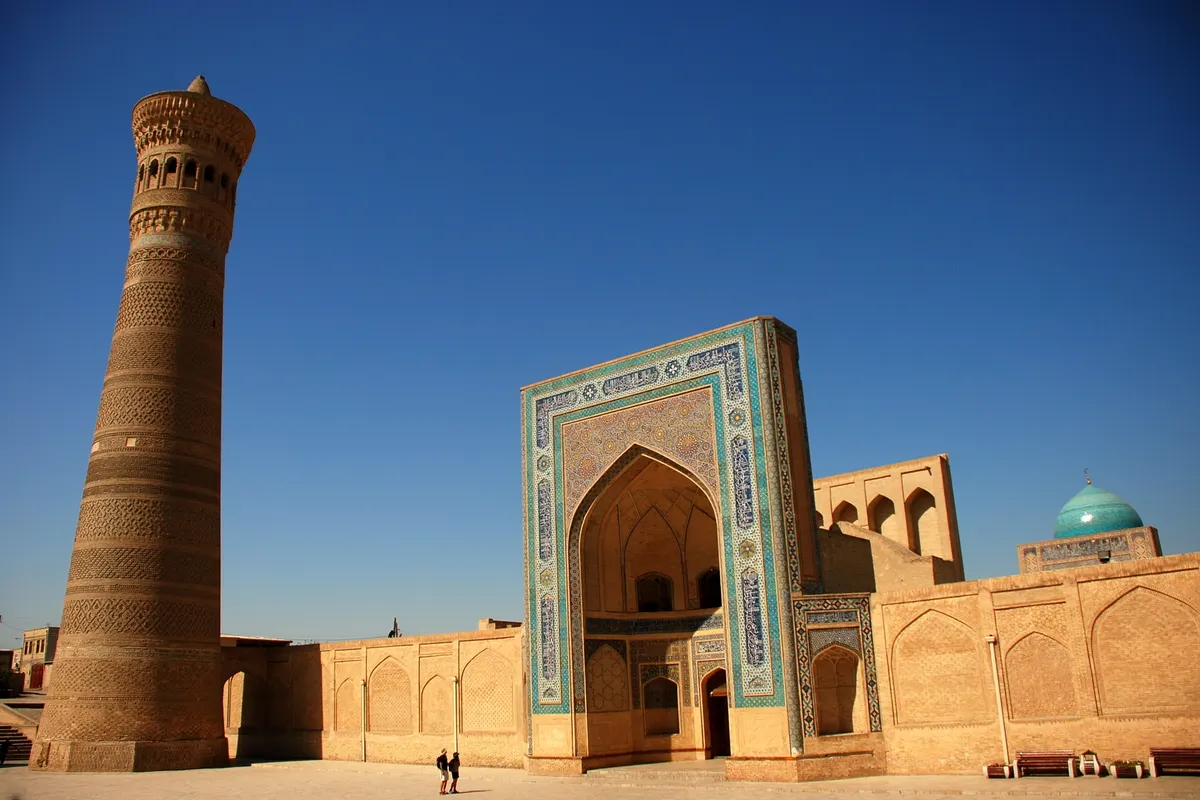
Tashkent is Uzbekistan's central transhipment point and an important node for plant and industrial projects in the region. Country details and requirements can be found on our page on heavy haulage to Uzbekistan.
Feasibility and planning from a single source
Before dispatch planning, we record weight, dimensions and centre of gravity, define the axle load concept and, in parallel, clarify ferry capacity in Baku for the specific item. The long overland stages in Kazakhstan are checked for bridge capacity and road condition. Oversize Transports – a brand of HSNK s.r.o. from Prague – executes the lane independently; send us your project by phone or via the form.
Buffers, time windows and ferry frequency
On the long southern route, the night driving and weekend restrictions of many countries interlock, and the on-demand Caspian ferry is the real pacemaker. We plan generous time buffers and synchronise the overland permits so that they do not expire if the crossing is delayed. The opening hours of the Kapıkule, Sarp and Red Bridge border crossings, as well as Kazakh driving-time rules, feed in on top. This buffer logic is what distinguishes robust planning from a mere mileage estimate.
Typical cargo types on this lane
Consignments moving to Tashkent via the southern route frequently include plant components for mining and energy, transformers, vessels, construction machinery and industrial modules. Such goods often involve excess weight, excess height or an unfavourable centre of gravity that shape the equipment concept and the ferry loading. We match trailer, axle lines and securing equipment precisely to each item and document condition and dimensions before departure, so that the permit data remains consistent across all borders. Oversize Transports – a brand of HSNK s.r.o. from Prague – executes the lane independently and without network ties.